Showing posts with label 4Ps Business and Marketing. Show all posts

Thursday, November 01, 2012

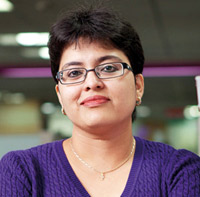
Aparna Ballakur (Vice President – HR, Yahoo! in India) tells Sayani Sinha Roy the Yahoo! workforce settles for nothing less than an addictive combination of Work, Opportunity, and Workplace

Q. How does Yahoo! retain its top employees?
A. At Yahoo! we settle for nothing less than an addictive combination of work, opportunity and workplace, or ‘WOW’, as we call it. The ‘work’ we do is fun, since we build cool stuff that impacts over 700 million users on the internet. I think the ability to touch millions of people across the world on a daily basis continues to be one of the most appealing aspect. Our employees get the ‘opportunity’ to work on bleeding edge innovation, alongside some of the best minds in the business. The opportunity that we give to our employees is our USP. We have created a work environment that is flexible, open and conducive to building a diverse and inclusive workforce.
Q. How has Yahoo! evolved in your tenure?
A. Yahoo! was early to realise India’s potential to emerge as an epicentre of high-end R&D, delivering strong internet products. We started with a small team and today R&D centre at Bangalore is the second largest R&D hub of Yahoo!

In the last few years, the centre has leapt the value chain, reinventing itself from an engineering centre to a customer-centric innovation hub that is making a strategic impact globally.

Q. Based on your experience, what role does HR play in M&A?
A. M&A brings unique people challenges that are outside the domain of business’ regular functioning. By keeping people issues front and centre, understanding HR’s role in each of the critical phases of the deal’s life cycle, and facilitating smooth culture integration, HR can effectively support the business and help achieve solid results from the transaction. A good way to measure a successful M&A is to pay attention to retention and engagement and ensuring that the new latent is leveraged well.

Q. Define your leadership style.
A. I believe in guiding, setting and communicating clear direction, goals and plans for my team and then leave it on them as to how they want to execute it. I feel that micromanagement can erode the confidence and motivation of employees. It is important for a leader to be direct. You need to clearly establish performance expectations and commitments with your employees and others. I believe in clearly identifying the goals and roles in the organisation and then helping leaders understand what they need to accomplish with teams.

Q. How do you manage time between work and family?
A. I believe in work-life integration and do not compartmentalise the two. You need to prioritise time; there will be days when work will take precedence and days when you will need to take time off for a family commitment. It is rare that on the same day you have pressing issues on both the sides. click here to continue...

Read More IIPM Related Articles
Zee Business Best B-School Survey 2012
Prof. Arindam Chaudhuri's Session at IMA Indore
IIPM IN FINANCIAL TIMES, UK. FEATURE OF THE WEEK
IIPM strong hold on Placement : 10000 Students Placed in last 5 year
IIPM's Management Consulting Arm-Planman Consulting
Professor Arindam Chaudhuri - A Man For The Society....
IIPM: Indian Institute of Planning and Management
IIPM makes business education truly global
Management Guru Arindam Chaudhuri
Rajita Chaudhuri-The New Age Woman
IIPM B-School Facebook Page
IIPM Global Exposure
IIPM Best B School India
IIPM B-School Detail
IIPM Links
IIPM : The B-School with a Human Face

Friday, July 13, 2012

“There is pressure on Indian banks to consolidate”

Dr. Rupa Rege Nitsure, Chief Economist of Bank of Baroda talks to B&E on whether Indian banks are ready for tough days ahead

B&E: Is the Indian banking industry in a position to grow and survive if the economic scenario deteriorates further and if recession strikes the Indian and global economy?
Dr. Rupa Rege Nitsure (DRRN):
In the global context, India is the second fastest growing economy (vis-à-vis other large-sized economies) and has a well-balanced economic structure. It is not highly dependent either on foreign financing or foreign demand, as some other countries are. And its banking sector is well capitalised and enjoys a c. Moreover, the Reserve Bank of India did demonstrate a high degree of flexibility and responsiveness during the last global financial meltdown. So even if the economic scenario worsens, our banking industry and its regulators are in a position to handle the situation well.

B&E: But NPAs are a concern – you cant deny that. How serious a concern are NPAs for Indian banks at this point of time as per you?
DRRN:
Banks always see some growth in their NPAs during cyclical downturns and that cannot be ruled out this time also. However, no alarming signals are visible as of today. The Indian banking industry’s gross NPAs stood at 2.3% during 2010-11 and rating agencies & banking analysts expect this to grow by 3 percentage points in the current financial year, which is quite reasonable in the current phase of high inflation and interest rates. So honestly, NPAs are not a big concern.

B&E: Do you believe that new banking licenses can play a significant role in achieving complete financial inclusion?
DRRN:
That may not happen automatically. The RBI will have to actively administer in order to ensure that new private banks play their contributory role in the mammoth task of financial inclusion. Without an active policy intervention, this “objective” cannot be met. Going by the experience so far, it is a misnomer to think that unbanked areas and disadvantaged sections would be served by the newest of the private banks.

B&E: At 20.2%, Bank of Baroda has posted a reasonable y-o-y rise in profit during the last quarter, which amounted to Rs.10.33 billion along with a 23.6% rise in net interest income. But considering that forecasts for the Indian economy is appearing more and more discouraging by the month, on what note do you expect to end the current financial year?
DRRN:
Given the bank’s well-diversified domestic and international loanbook, modest exposure to sensitive sectors, relatively higher proportion of low-cost (CASA) deposits, good traction of fee-based income and lowest incremental delinquency ratios (in the Indian banking sector) for the past several quarters, we are confident to end the current financial year successfully, and consistent with our past performance.
B&E: NPAs don’t worry you. Even a slowing economy doesn’t. Then what does? Isn’t there something which Bank of Baroda is concerned about?
DRRN: The bank does not have any concern intrinsic to its own operations. But uncertain economic situation and volatility in financial markets are enough concerns for any banking entity to remain vigilant and responsive to early warning signals. So we are not immune to turmoil in the macroeconomic scenario – both domestic and global. No one entity is.

B&E: The bank’s total business expanded by 23.9% (y-o-y) to Rs.5.45 trillion in Q1FY2012. Doesn’t such a financial performance set you thinking of plans for further business expansion? Also, how do you plan to retain the current margin levels?
DRRN:
The bank’s business focus in the past few years has been “Sustainable growth with a focus on quality”. Hence, the key focal point for us is to give an acceptable “Return on Average Assets” to all our stakeholders, than concentrate on and worry about “size”. We have been managing our profit margin well through better Current Account-Savings Account (CASA) mobilisation, prudent pricing of retail term deposits, efficient pricing of loans and minimisation of credit costs.

B&E: How important is the retail banking business to Bank of Baroda? How much does retail banking contribute to the bank’s annual revenues?
DRRN:
For any bank in a country like India which has a strong demographic profile, retail banking is a major growth driver. In the bank’s domestic credit book, the share of retail loans has always remained between 18.0% to 20.0% for the last seven-eight years. The yield on retail advances is also relatively higher and to that extent it is definitely a strong value proposition. However, given the Bank’s thrust on “diversification”, the Bank has avoided the temptation of growing aggressively in any one direction. So we may not become the biggest retail players, but we will definitely be amongst the strongest in this respect.

B&E: Which sectors will play a role in accelerating the growth of the Indian banking industry in near future?
DRRN:
The Indian banking industry will see good growth opportunities in agriculture & agro-based industries and in sectors like pharmaceuticals, food processing and services, in near future. However, from a long term perspective, the infrastructure sector will continue to be the main growth driver.


Saturday, July 07, 2012

Chinese Fire vs Indian Thunder

Considering how they made The Incumbents Bleed, both Micromax and G’Five have been Revelations in The Indian Mobile handset Industry. Now they are Increasingly getting in each Other’s Way

Ages ago, Charles Darwin coined the phrase “survival of the fittest”. His words make all the more sense in today’s era where change happens overnight. And verdicts are given on the victor and the vanquished in much lesser time. In fact, one can safely adapt Darwin’s theory and say that this is the era of survival of the “fittest and the swiftest”. The Indian handset industry, with estimated sales of around 10-12 million units every month, currently has its hands full with a number of players already in the race for a slice of the pie; of course, the larger, the better. But with that perspective, comes the fact that there are always newer players looking to get their foot inside the doorstep. This market, which earlier boasted of only a handful others, was redefined a few years back by a clutch of companies, which made the incumbents bleed, and profusely. Micromax and G’five are two brands, in particular, that emerged from the resultant hostilities to become prominent players in their own right. And while they both have benefitted from attacking the leaders, they are off late increasingly finding themselves in each other’s way. And given the fact that they perhaps are the most acerbic competitors in the market front, 4Ps B&M decided to cover them in this section of Marketers@War..

Micromax established a new business model in India by importing handsets – as there are no duties levied – and selling them in the Indian handset market. Most imports are occurring from China, Hong Kong, Taiwan and other east Asian countries. Off late, the Chinese players have also realised the potential and growth opportunities and entered directly. And Honk Kong based G’Five, irrespective of its lineage (how many of us associate Hong Kong with consumer electronics?), is playing on similar tunes.

Micromax and G’Five are competing in the Indian market on a common principle – offering exceptional value for money to their users and becoming the alternatives to the incumbent MNCs. However, they are not similar in their actual method of approach. Micromax, since its inception, has adopted an aggressive marketing campaign to promote its brand. It has leveraged both cricket and Bollywood (it roped in Bollywood superstar Akshay Kumar, a testimony to its ambitions) and indulged in a number of visibility campaigns. “Our target audience identifies itself with cricket, Bollywood and music. That is why we have been marketing our product around them,” points out Pratik Seal, Head Marketing, Micromax.

On the other hand, G’Five has remained a silent killer in the industry and hardly promoted its products or its brand at the national level. It therefore came as a shock when IDC reported that G’Five has emerged as the largest handset player in India after Nokia for the quarter ending September 2010. Nokia further slipped by around 5% to post a market share of 31.5% and G’Five took the second spot with 10.6%; beating Samsung at 8.2%.“Yes, I agree that G’Five as a brand was not visible in the Tier I cities and metros. But we have been doing enough branding and marketing campaigns in Tier II and III cities,” says Arshit Pathak, Managing Director, G’Five. In the initial stages, the company has been targeting Tier II and Tier III cities, and 80% of sales of G’Five handsets are coming from these cities. After having reached a formidable position, G’Five is now positioning itself in metros and Tier I cities. It is also looking forward to tie-ups with some of the large format retail outlets.

For more articles, Click on IIPM Article

Source : IIPM Editorial, 2011.

An Initiative of IIPM, Malay Chaudhuri and Arindam chaudhuri (Renowned Management Guru and Economist).

For More IIPM Info, Visit below mentioned IIPM articles.
IIPM Best B School India
Management Guru Arindam Chaudhuri
Rajita Chaudhuri-The New Age Woman
IIPM's Management Consulting Arm-Planman Consulting

IIPM Proves Its Mettle Once Again.....

IIPM Prof. Arindam Chaudhuri on Internet Hooliganism
Arindam Chaudhuri: We need Hazare's leadership
Professor Arindam Chaudhuri - A Man For The Society....
IIPM: Indian Institute of Planning and Management
IIPM RANKED NO.1 in MAIL TODAY B-SCHOOL RANKINGS
Planman Technologies

Thursday, March 01, 2012

An expression that changed India

Amidst all the tumultuous times that telecom saw in India, the Bharti Airtel brand has managed to stay on top. But things are getting even tougher...

“A pessimist sees the difficulty in every opportunity; an optimist sees the opportunity in every difficulty.” Chairman and Group CEO Bharti Enterprise Sunil Bharti Mittal’s entry into the telecom business was accidental. Mittal, an importer of portable electric generators, was overnight out of business in the early 1980s when the then government banned imports of generators in India. It was his sheer enterprising ability and sensing of opportunity in difficulty, which took him ahead. While roaming around in Taiwan, he happened to notice the popularity of push-button phones. At that time, Indian users were still struggling with rotary dials phones with no speed dials or a redial button. He sensed the opportunity and started promoting push button telephones, answering and fax machines under the Beetel brand. Mittal’s vision turned the Rs.20,000 investment, which he had borrowed from his father to start the manufacturing of bicycle crankshafts for local manufacturers, into a $ 8.3 billion company (as per Forbes India).

Mittal also learned that while your first venture is the closest to your heart, it is rarely your big bang. In 1995, Mittal entered into the telecom services space with Airtel, which ultimately became the big bang he was looking for. At that time, the cost of handsets was around Rs.45,000, equivalent to the price of a pre-owned Fiat; and call charges were as high as Rs.16 per minute. But Mittal was confident about the services as it had given Indians the “Power to keep in Touch” with their loved ones, friends and business associates 24X7. And that is the reason why Bharti Airtel launched its first positioning as ‘Power to keep in touch’. At that time the target audience of the services was the elite group of age 25 years and above. This positioning was retained for over five years.

In 1999, when the new National Telecom Policy (NTP) was announced, the rules of the game suddenly changed. The new policy replaced the license fee with a revenue sharing scheme and extended the period of license to 20 years from 10. The service provider passed the benefits to users, resulting in cheaper tariff rates and greater penetration into Tier I cities. Mobile tariffs had come down to Rs.4 per minute and handsets became available at around Rs.15,000. Handsets became slim and SMS was introduced as a service. Pre-paid services were born, helping users to keep a tab on the usage. Bharti then repositioned itself with the punch line – Touch Tomorrow – and also started targeting youths below 25 years with handsome purchasing power.

Come 2002 and Airtel roped in A. R. Rehman. It was the first and last brand that A. R. Rehman got associated with. At the same time, Airtel also repositioned itself on the emotional plank with ‘Live every moment’. Since then, Bharti’s branding exercise has retained an emotional appeal. “Over the years, the brand has evolved to reflect the changing environment and customer preferences. In 2002, we introduced the current identity of our brand and since then, the revenues of this brand have grown by nearly 50 times, with our customer base increasing by 80% year on year,” says Mohit Beotra, Head- Emerging Business, Bharti Airtel.

For more articles, Click on IIPM Article

Source : IIPM Editorial, 2012

An Initiative of IIPM, Malay Chaudhuri and Arindam chaudhuri (Renowned Management Guru and Economist).

For More IIPM Info, Visit below mentioned IIPM articles.

IIPM Best B School India
Management Guru Arindam Chaudhuri
Rajita Chaudhuri-The New Age Woman
IIPM's Management Consulting Arm-Planman Consulting

IIPM Proves Its Mettle Once Again.....

IIPM Prof. Arindam Chaudhuri on Internet Hooliganism
Arindam Chaudhuri: We need Hazare's leadership
Professor Arindam Chaudhuri - A Man For The Society....
IIPM: Indian Institute of Planning and Management
IIPM RANKED NO.1 in MAIL TODAY B-SCHOOL RANKINGS
Planman Technologies

Thursday, December 29, 2011

Chinese Fire vs Indian Thunder

Considering how they made The Incumbents Bleed, both Micromax and G’Five have been Revelations in The Indian Mobile handset Industry. Now they are Increasingly getting in each Other’s Way

Ages ago, Charles Darwin coined the phrase “survival of the fittest”. His words make all the more sense in today’s era where change happens overnight. And verdicts are given on the victor and the vanquished in much lesser time. In fact, one can safely adapt Darwin’s theory and say that this is the era of survival of the “fittest and the swiftest”. The Indian handset industry, with estimated sales of around 10-12 million units every month, currently has its hands full with a number of players already in the race for a slice of the pie; of course, the larger, the better. But with that perspective, comes the fact that there are always newer players looking to get their foot inside the doorstep. This market, which earlier boasted of only a handful others, was redefined a few years back by a clutch of companies, which made the incumbents bleed, and profusely. Micromax and G’five are two brands, in particular, that emerged from the resultant hostilities to become prominent players in their own right. And while they both have benefitted from attacking the leaders, they are off late increasingly finding themselves in each other’s way. And given the fact that they perhaps are the most acerbic competitors in the market front, 4Ps B&M decided to cover them in this section of Marketers@War..

Micromax established a new business model in India by importing handsets – as there are no duties levied – and selling them in the Indian handset market. Most imports are occurring from China, Hong Kong, Taiwan and other east Asian countries. Off late, the Chinese players have also realised the potential and growth opportunities and entered directly. And Honk Kong based G’Five, irrespective of its lineage (how many of us associate Hong Kong with consumer electronics?), is playing on similar tunes.

Micromax and G’Five are competing in the Indian market on a common principle – offering exceptional value for money to their users and becoming the alternatives to the incumbent MNCs. However, they are not similar in their actual method of approach. Micromax, since its inception, has adopted an aggressive marketing campaign to promote its brand. It has leveraged both cricket and Bollywood (it roped in Bollywood superstar Akshay Kumar, a testimony to its ambitions) and indulged in a number of visibility campaigns. “Our target audience identifies itself with cricket, Bollywood and music. That is why we have been marketing our product around them,” points out Pratik Seal, Head Marketing, Micromax.

On the other hand, G’Five has remained a silent killer in the industry and hardly promoted its products or its brand at the national level. It therefore came as a shock when IDC reported that G’Five has emerged as the largest handset player in India after Nokia for the quarter ending September 2010. Nokia further slipped by around 5% to post a market share of 31.5% and G’Five took the second spot with 10.6%; beating Samsung at 8.2%.“Yes, I agree that G’Five as a brand was not visible in the Tier I cities and metros. But we have been doing enough branding and marketing campaigns in Tier II and III cities,” says Arshit Pathak, Managing Director, G’Five. In the initial stages, the company has been targeting Tier II and Tier III cities, and 80% of sales of G’Five handsets are coming from these cities. After having reached a formidable position, G’Five is now positioning itself in metros and Tier I cities. It is also looking forward to tie-ups with some of the large format retail outlets.

For more articles, Click on IIPM Article

Source : IIPM Editorial, 2011.

An Initiative of IIPM, Malay Chaudhuri and Arindam chaudhuri (Renowned Management Guru and Economist).

For More IIPM Info, Visit below mentioned IIPM articles.

IIPM Best B School India
Management Guru Arindam Chaudhuri
Rajita Chaudhuri-The New Age Woman
IIPM's Management Consulting Arm-Planman Consulting

IIPM Proves Its Mettle Once Again.....

IIPM Prof. Arindam Chaudhuri on Internet Hooliganism
Arindam Chaudhuri: We need Hazare's leadership
Professor Arindam Chaudhuri - A Man For The Society....
IIPM: Indian Institute of Planning and Management
IIPM RANKED NO.1 in MAIL TODAY B-SCHOOL RANKINGS
Planman Technologies

Tuesday, March 15, 2011

“IT SYMBOLISES STRENGTH TO ME”

With India entering the league of a select few who have their own currency symbol, the creator of the new symbol for the Indian rupee shares with 4Ps B&M the symbolic meaning of the creation, his research and the cultural roots etched deep into the symbol

How does it feel to be the man behind our new rupee symbol?
It feels great to be able to become a part of something that will give this country its own visual recognition globally. Actually, the feeling is quite phenomenal.

What did you want to portray while the design was still in your mind?
When the Government of India had announced this competition, if you can call it that, there were certain guidelines to be followed. We were supposed to work on something that will reflect our culture. So I was focussing on how the Indian culture could be best portrayed. I did a lot of research on Indian scripts as I had already done my PhD in the Tamil script. After a lot of research, I decided to use the Devnagri script.

Why the Devnagri Script?
I could not afford to miss the uniqueness of this script. While every other currency symbol in the world starts from the baseline, it is only in Devnagri script that you write from the topline. I tried many other options, but this was unique among other scripts. I thought this will represent India’s identity distinctly!

What does the symbol symbolize to you now?
It symbolises strength to me. All this while, I had the same concept in my mind. It was a strong concept then, it is still a strong one after it got selected. The verdict has not changed anything for me, I see the symbol in the same manner as I did when I created it. Even people will see it in the same light.

Would this symbol change India’s stand globally?
It has given the nation’s currency a visual recognition, which is an important landmark in itself. I think it has brought about a face value to Indian currency. More importantly, it has served as a symbol of differentiation among our seven neighbouring countries that have the same currency as the rupee.

For more articles, Click on IIPM Article.

Source : IIPM Editorial, 2011.

An Initiative of IIPM, Malay Chaudhuri and Arindam chaudhuri (Renowned Management Guru and Economist).

For More IIPM Info, Visit below mentioned IIPM articles.

IIPM B-School Detail
IIPM makes business education truly global
IIPM’s Management Consulting Arm - Planman Consulting
Arindam Chaudhuri (IIPM Dean) – ‘Every human being is a diamond’
Arindam Chaudhuri – Everything is not in our hands
Planman Technologies – IT Solutions at your finger tips
Planman Consulting
Arindam Chaudhuri's Portfolio - he is at his candid best by Society Magazine

IIPM B-School
Arindam Chaudhuri
Rajita Chaudhuri
Planman Consulting


IIPM Proves Its Mettle Once Again....